29-June-2026
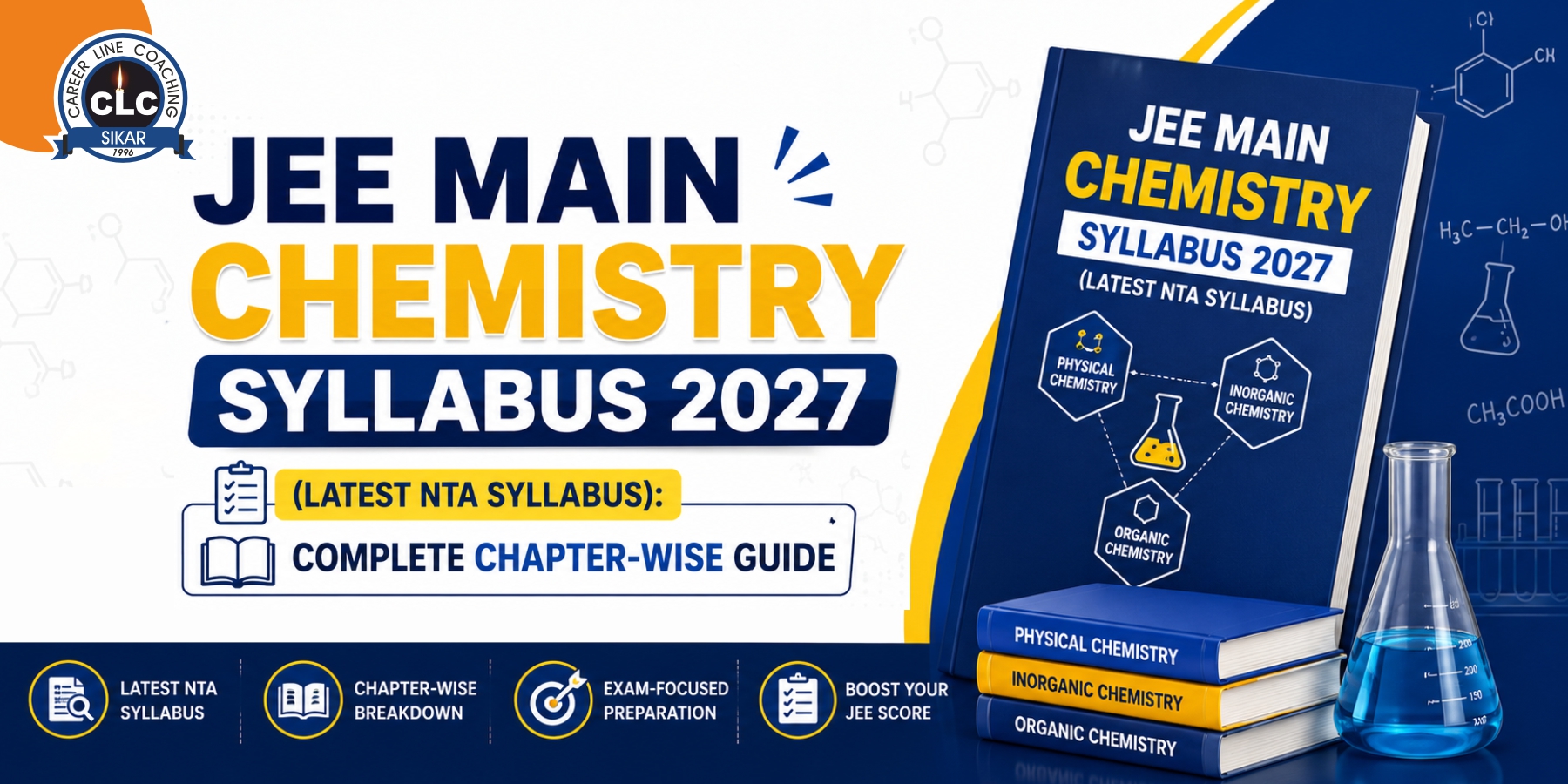
JEE Main Chemistry Syllabus 2027 (Latest NTA Syllabus): Complete Chapter-Wise Guide
If you're in the process of preparing for JEE Main 2027 The first step to preparing effectively is knowing the latest Chemistry syllabus. Chemistry is thought to be one of the highest successful subjects on the JEE Main exam because it has a mix of theoretical, conceptual, and numerical tests. An understanding of the syllabus will help students focus on the most crucial areas, design a successful study strategy, and avoid wasting hours on chapters that are not relevant to their studies.
According to the most recent available syllabus published through the National Testing Agency (NTA) the JEE's main Chemistry Syllabus 2027 is expected to be based on the current syllabus, unless changes are officially declared. This syllabus has been divided into three sections: Physical Chemistry, Organic Chemistry, and Inorganic Chemistry, with questions that are primarily based upon those from the NCERT Class 11 and 12 syllabus.
In this blog you'll find the entire chapter-wise syllabus, the most important subjects, tips for preparing and the solutions to the most frequently-asked questions.
Also Read : JEE Main Syllabus 2027 PDF
📋 Table of Contents
▲- JEE Main Chemistry Syllabus 2027 Overview
- JEE Main Physical Chemistry Syllabus 2027
- JEE Main Inorganic Chemistry Syllabus 2027
- JEE Main Organic Chemistry Syllabus 2027
- Complete Chapter-Wise JEE Main Chemistry Syllabus 2027
- Important Topics in JEE Main Chemistry 2027
- Preparation Tips for JEE Main Chemistry 2027
- Why Understanding the JEE Main Chemistry Syllabus is Important
- Conclusion
- FAQs
JEE Main Chemistry Syllabus 2027 Overview
The Chemistry section in JEE Main tests a student's understanding of scientific concepts, problem-solving ability, and application of formulas. The syllabus covers topics from both Class 11 and Class 12 and is divided into three major sections:
- Physical Chemistry
- Organic Chemistry
- Inorganic Chemistry
Each section carries significant weightage in the examination, making it important for students to prepare all three equally.
JEE Main Physical Chemistry Syllabus 2027
Physical Chemistry focuses on concepts, formulas, and numerical problem-solving. Students should develop strong conceptual clarity and practice calculations regularly.
Chapters Included
- Some Basic Concepts of Chemistry
- Atomic Structure
- States of Matter
- Chemical Bonding and Molecular Structure
- Chemical Thermodynamics
- Solutions
- Equilibrium
- Redox Reactions
- Electrochemistry
- Chemical Kinetics
- Surface Chemistry
Most numerical questions in JEE Main Chemistry are asked from these chapters, making regular practice essential.
JEE Main Inorganic Chemistry Syllabus 2027
Inorganic Chemistry is largely theory-based and requires consistent revision. Since many questions are directly based on NCERT, students should pay special attention to definitions, properties, and reactions.
Chapters Included
- Classification of Elements and Periodicity
- Hydrogen
- s-Block Elements
- p-Block Elements
- d- and f-Block Elements
- Coordination Compounds
- General Principles and Processes of Isolation of Metals
- Environmental Chemistry
Reading NCERT thoroughly and revising regularly can help students score well in this section.
JEE Main Organic Chemistry Syllabus 2027
Organic Chemistry is concept-oriented and requires a proper understanding of reaction mechanisms rather than memorization.
Chapters Included
- Purification and Characterisation of Organic Compounds
- Some Basic Principles of Organic Chemistry
- Hydrocarbons
- Organic Compounds Containing Halogens
- Organic Compounds Containing Oxygen
- Organic Compounds Containing Nitrogen
- Biomolecules
- Principles Related to Practical Chemistry
Students should focus on understanding reaction mechanisms, conversions, and important name reactions.
Complete Chapter-Wise JEE Main Chemistry Syllabus 2027
Class 11 Chemistry Topics
- Some Basic Concepts of Chemistry
- Atomic Structure
- Classification of Elements and Periodicity
- Chemical Bonding and Molecular Structure
- States of Matter
- Thermodynamics
- Equilibrium
- Redox Reactions
- Hydrogen
- s-Block Elements
- Some p-Block Elements
- Organic Chemistry – Basic Principles
- Hydrocarbons
- Environmental Chemistry
Class 12 Chemistry Topics
- Solid State (if included in the latest official syllabus update, follow NTA notification)
- Solutions
- Electrochemistry
- Chemical Kinetics
- Surface Chemistry
- General Principles and Processes of Isolation of Metals
- p-Block Elements
- d- and f-Block Elements
- Coordination Compounds
- Haloalkanes and Haloarenes
- Alcohols, Phenols and Ethers
- Aldehydes, Ketones and Carboxylic Acids
- Amines
- Biomolecules
- Principles Related to Practical Chemistry
Also Read : JEE Main Physics Syllabus 2027
Important Topics in JEE Main Chemistry 2027
Although every chapter is important, some topics have consistently carried good weightage in previous JEE Main examinations.
These include:
- Mole Concept
- Chemical Bonding
- Thermodynamics
- Equilibrium
- Electrochemistry
- Chemical Kinetics
- Coordination Compounds
- p-Block Elements
- Organic Reaction Mechanism
- Hydrocarbons
- Biomolecules
Students should revise these topics multiple times while ensuring that no chapter is left uncovered.
Preparation Tips for JEE Main Chemistry 2027
Preparing for Chemistry becomes easier with a systematic approach. Instead of studying randomly, students should complete the syllabus chapter by chapter and revise regularly.
Here are a few useful preparation tips:
- Start with NCERT concepts before moving to advanced questions.
- Prepare short notes for formulas, reactions, and important concepts.
- Practice numerical questions daily for Physical Chemistry.
- Revise Inorganic Chemistry frequently to improve retention.
- Understand reaction mechanisms instead of memorizing Organic Chemistry.
- Solve previous years' JEE Main question papers to understand the exam pattern.
- Attempt mock tests regularly to improve speed and accuracy.
- Revise the complete syllabus multiple times before the examination.
Consistency and revision are the keys to scoring well in Chemistry.
Why Understanding the JEE Main Chemistry Syllabus is Important
Many students begin their preparation without checking the official syllabus, which often leads to unnecessary study and confusion. Knowing the syllabus helps you:
- Focus only on exam-relevant topics.
- Create an effective study timetable.
- Identify high-priority chapters.
- Allocate equal time to all three branches of Chemistry.
- Complete the syllabus well before the examination.
A syllabus-based preparation strategy increases confidence and improves overall performance in JEE Main.
Conclusion
The Chemistry syllabus for JEE Main 2027 comprises of various topics from Class 11 and Class 12 Chemistry and plays a crucial role in the examination. The Chemistry paper has the following points: There are theoretical, conceptual and numerical questions, so student should prepare all three parts of Chemistry i.e. Physical, Organic, and Inorganic Chemistry equally.
DON'T just do a few key chapters, work through the whole syllabus and edit it regularly. By practicing regularly, understanding the concepts, and using past years' questions, you will gain the accuracy and maximize your marks in JEE Main 2027.
Enquire Now at CLC Sikar – Build Your Path to Top IITs & Medical Colleges!
FAQs
Q1. Is the JEE Main Chemistry syllabus for 2027 different from 2026?
As of now, no major changes have been officially announced. Students should follow the latest syllabus released by the National Testing Agency (NTA) and check for any future updates.
Q2. Which section of Chemistry is the most scoring in JEE Main?
Many students find Inorganic Chemistry the most scoring because several questions are directly based on NCERT concepts. However, scoring well requires balanced preparation across all three sections.
Q3. Are Class 11 and Class 12 Chemistry both important for JEE Main 2027?
Yes. The JEE Main Chemistry syllabus includes topics from both Class 11 and Class 12, and questions are asked from both classes in the examination.
CLC Editorial Team
Our Latest Blog
NEET UG Round 3 New 183 Seats:...
There are 183 more MBBS and BDS seats available inRead More
CLC TECNO 2027 Registration : ...
CLC Sikar has opened registrations for CLC TECNO 2Read More
NEET UG Round 3 New 183 Seats:...
There are 183 more MBBS and BDS seats available inRead More