2-September-2024
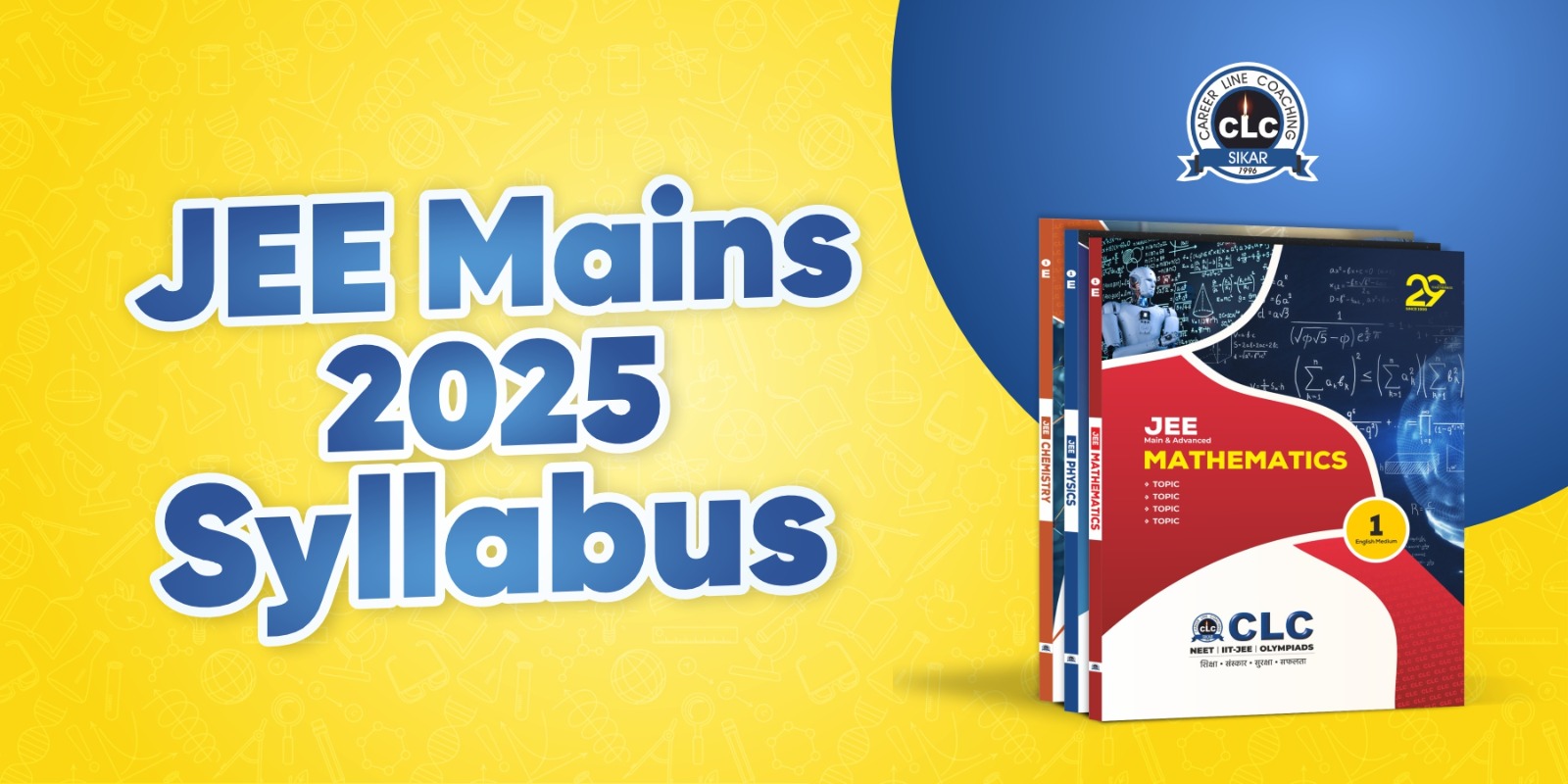
JEE Mains 2025 Syllabus
To prepare for JEE Main 2025 preparation, it is crucial to know all topics included during the JEE Main exam. With the help of the JEE Main 2025 syllabus candidates will understand the essential and important topics to concentrate on.It is expected that the National Testing Agency (NTA) will conduct the JEE Mains 2025 in two sessions in the months of January and April 2025. The complete notification regarding JEE Mains 2025 will be published in the month of November 2024. JEE Mains syllabus 2025 PDF will be made available through the NTA on its official website jeemain.nta.ac.in and will also be released a brochure that will cover all details of the exam. JEE Mains 2025 syllabus is divided into three parts: mathematics, chemistry, and physics.
The syllabus plays an important role during your JEE Main 2025 preparation journey. It gives you knowledge about the topics to be covered but also help candidates to understand areas could be eliminated and help to save time.It aids candidates be focused on their study in the right direction. Those who have passed their JEE Main 2025 exam will be able to sit for the JEE Advanced 2025 to be considered for IIT admissions. Check out the most updated JEE Main course to help prepare for the upcoming JEE Main exam 2025. It consists of the essential topics that have weightage based on marks. Below, you will find the updated and comprehensive topics-specific JEE Main 2025 syllabus.
📋 Table of Contents
▲- JEE Main 2025 Exam Date
- Is JEE Main 2025 Syllabus has been reduced?
- JEE Mains 2025 Syllabus PDF
- JEE Main 2025 Physics Syllabus
- JEE Main 2025 Chemistry Syllabus
- Jee Main 2025 Mathematics Syllabus
- JEE Main Syllabus 2025 For Paper 1
- JEE Main Exam Pattern 2025
- JEE Main Exam Pattern 2025 For 2 A and 2 B
- Jee Main 2025 Marking System
- Conclusion:
JEE Main 2025 Exam Date
A JEE Main Date for 2025's exam will be announced at a later date, possibly in November 2024. It is expected that the JEE Main 2025 Exam will be conducted over two days. Session 1 will take place in January 2025 and Session 2 will be held in April 2025. Below is the approximate JEE Main 2025 exam date.
| Events | JEE Main 2025 Session 1 Dates | JEE Main 2025 Session 2 Dates |
| JEE Main 2025 Notification | November | |
| JEE Main 2025 Application form | November | February |
| Last date to apply | December | March |
| Release of JEE Main Admit Card 2025 | January | April |
| JEE Main 2025 Exam Date | January 2nd week | April 2nd week |
| Announcement of Result | February 1st week | April last week |
Is JEE Main 2025 Syllabus has been reduced?
NTA has reduced the syllabus of JEE Mains exam by reducing the syllabus of JEE Mains exam last year by removing a number of topics in Physics, Chemistry and Mathematics. The updated syllabus is similar to those of Class 11 and Class 12 syllabus of NCERT/CBSE. questions in the JEE Main exam will be according to those in the JEE Main syllabus. The following are the subjects deleted from the JEE Main syllabus:
Physical Science: The syllabus is deleted of the unit on communication devices.
Chapters in Chemistry: Surface Chemistry, States of Matter, General Principles and Methods of Isolation of metals, S-block element, Hydrogen, Environmental Chemistry, Alcohol Phenol, Ether and Polymers have been eliminated.
Mathematics: Mathematical Reasoning units and mathematical induction vanish as well.
Read Also: How Many Attempts for JEE Mains
JEE Mains 2025 Syllabus PDF
It is expected that the JEE Main 2025 exam will be administered for three exams Paper 1 to test BE/BTech Paper 2A to B Arch as well as Paper 2B to test B Plan. In the JEE Main exam of 2025, syllabus for Paper 1 includes Class 11th-12th Science, Chemistry and Mathematics. Paper 2A Architecture (BArch) comprises topics on Mathematics and General aptitude and Drawing, while Paper 2B (BPlan) is a more general Paper 2B (BPlan) syllabus comprises Mathematics and General Aptitude and topics for planning.
JEE Main 2025 Physics Syllabus
Scroll down for the complete JEE Main 2025 topic-wise physics syllabus.
| Unit | Topics |
| Unit.1:Physical World and Measurement | Physical world and measurement, Units and measurements, Error analysis |
| Unit.2: Kinematics | Motion in a straight line, Motion in a plane, Projectile motion, Uniform circular motion |
| Unit.3:Laws of Motion | Newton’s laws of motion, Friction, Circular motion and its dynamics |
| Unit.4:Work, Energy, and Power | Work done by a force, Energy, Kinetic and potential energy, Power and its units |
| Unit.5:Motion of System of Particles and Rigid Body | Center of mass, Rotational motion, Torque and angular momentum, Moment of inertia, Dynamics of rigid bodies |
| Unit.6:Gravitation | Universal law of gravitation, Gravitational potential energy, Satellite motion |
| Unit.7:Properties of Bulk Matter | Elasticity, Viscosity, Thermal properties of matter, Thermal expansion |
| Unit.8:Thermodynamics | Laws of thermodynamics, Heat engines, Carnot engine, Entropy and its applications |
| Unit.9:Behaviour of Perfect Gas and Kinetic Theory | Ideal gas laws, Kinetic theory of gases, Mean free path, Real gases |
| Unit.10:Oscillations and Waves | Simple harmonic motion,Damped and forced oscillations, Wave motion, Sound waves |
| Unit.11:Electrostatics | Electric charges and fields, Gauss's law, Electric potential, Capacitance |
| Unit.12:Current Electricity | Electric current, Ohm's law, Kirchhoff's laws, Electrical instruments |
| Unit.13:Magnetic Effects of Current and Magnetism | Magnetic field and force, Ampere's law, Magnetic properties of materials, Electromagnetic induction |
| Unit.14:Electromagnetic Induction and Alternating Currents |
Faraday’s law of induction, Lenz’s law, AC circuits, LC circuits, Transformer |
| Unit.15:Electromagnetic Waves | Electromagnetic spectrum,Propagation of electromagnetic waves, Applications |
| Unit.16:Optics | Ray optics, Wave optics, Interference, Diffraction, Polarization |
| Unit.17:Modern Physics | Photoelectric effect, Atomic models, Nuclear physics, Radioactivity,Semiconductors |
JEE Main 2025 Chemistry Syllabus
Three components comprise the JEE Main 2025 Syllabus: Section A-Physical Chemistry Section B inorganic Chemistry and Section C organic Chemistry. Here is the JEE main syllabus 2025 topic specific in Chemistry. The subjects are taken from the 11 and 12 classes syllabus.
Read Also: Difference Between JEE Main and Advanced
JEE Main Physical Chemistry Syllabus
| Unit | Topics |
| Unit.1:Some Basic Concepts in Chemistry | Mole concept - Laws of chemical combination - Atomic and molecular masses - Stoichiometry - Empirical and molecular formulas |
| Unit.2: States of Matter | - Gaseous state: Ideal gas laws, real gases, van der Waals equation - Liquid state: Properties of liquids - Solid state: Crystal lattices, unit cells, packing in solids, types of crystals, Bragg’s law |
| Unit.3:Atomic Structure | - Discovery of electron, proton, neutron - Rutherford’s model - Bohr’s model - Quantum mechanical model - Quantum numbers - Atomic orbitals - Electronic configuration - Pauli exclusion principle - Aufbau principle - Hund’s rule |
| Unit.4:Chemical Bonding and Molecular Structure | - Types of bonds: Ionic, covalent, metallic - Lewis structure - VSEPR theory - Hybridization - Molecular orbital theory - Hydrogen bonding |
| Unit.5:Chemical Thermodynamics | - First law of thermodynamics - Internal energy - Enthalpy - Specific heat - Hess’s law - Enthalpies of reactions - Spontaneity: Entropy, Gibbs free energy - Second law of thermodynamics |
| Unit.6:Equilibrium | - Dynamic nature of equilibrium - Law of mass action - Le Chatelier’s principle - Ionic equilibrium - Acids and bases - pH scale - Buffer solutions - Solubility product |
| Unit.7:Redox Reactions and Electrochemistry | - Oxidation and reduction - Redox reactions - Electrochemical cells - Galvanic cells - Nernst equation - Electrolysis and laws of electrolysis - Electrolytic conductance |
| Unit.8:Chemical Kinetics | Rate of a reaction - Order and molecularity - Integrated rate equations - Collision theory - Activation energy - Arrhenius equation |
| Unit.9:Surface Chemistry | - Adsorption - Catalysis - Colloids: Properties, preparation, and purification - Emulsions - Applications of colloids |
Inorganic Chemistry Syllabus for JEE Mains 2025
| Unit | Topics |
| Unit.1: Classification of Elements and Periodicity in Properties | - Modern periodic law and the present form of the periodic table - Periodic trends in properties: Ionization energy, electron affinity, atomic and ionic radii, electronegativity |
| Unit.2: General Principles and Processes of Isolation of Metals | - Principles of extraction - Concentration, reduction, and refining of ores - Extraction of aluminum, copper, zinc, and iron |
| Unit.3: Hydrogen | - Properties and uses - Isotopes of hydrogen - Hydrogen peroxide: Preparation, properties, and structure - Heavy water |
| Unit.4: s-Block Elements (Alkali and Alkaline Earth Metals) | - Group 1 elements: Lithium to cesium - Group 2 elements: Beryllium to radium - General properties and trends - Compounds of s-block elements: Sodium carbonate, sodium hydroxide, calcium oxide, etc. |
| Unit.5: p-Block Elements | Group 13 to Group 18 elements - General trends and properties - Compounds of boron, carbon, nitrogen, oxygen, halogens, and noble gases - Important compounds: Borax, orthoboric acid, diborane, CO, CO2, silicon carbide, ammonia, nitric acid, phosphine, phosphorus halides, oxoacids of phosphorus, sulfuric acid, chlorine, hydrochloric acid, interhalogen compounds, xenon fluorides |
| Unit.6: d- and f-Block Elements | - Transition elements: General properties and trends - Lanthanides and actinides: General properties and applications - Important compounds: Potassium dichromate, potassium permanganate, lanthanide contraction |
| Unit.7: Coordination Compounds | - Werner’s theory - Ligands and coordination number - Nomenclature - Isomerism - Bonding in coordination compounds - Stability and importance of coordination compounds |
| Unit.8: Environmental Chemistry | - Environmental pollution: Air, water, and soil pollution - Green chemistry: Principles and applications - Ozone depletion, greenhouse effect, acid rain |
Organic Chemistry Syllabus for JEE Mains 2025
| Unit | Topics |
| Unit.1: Purification and Characterization of Organic Compounds | - Methods of purification: Crystallization, distillation, chromatography - Qualitative analysis: Detection of elements (C, H, N, S, halogens) - Quantitative analysis: Estimation of carbon, hydrogen, nitrogen, halogens, and sulfur |
| Unit.2: Basic Principles of Organic Chemistry | - Classification and nomenclature - Hybridization of carbon - Structural and geometrical isomerism - Electronic effects: Inductive, resonance, hyperconjugation - Homolytic and heterolytic fission - Reaction intermediates: Carbocations, carbanions, free radicals - Types of organic reactions: Substitution, addition, elimination, and rearrangement |
| Unit.3: Hydrocarbons | - Alkanes: Preparation, properties, reactions - Alkenes: Preparation, properties, reactions, Markovnikov’s rule, peroxide effect - Alkynes: Preparation, properties, reactions - Aromatic hydrocarbons: Benzene, resonance, aromaticity, electrophilic substitution reactions |
| Unit.4: Haloalkanes and Haloarenes | - Nomenclature - Preparation and properties - Reactions: Nucleophilic substitution, elimination, and reaction mechanisms - Environmental effects: Pesticides, CFCs |
| Unit.5: Alcohols, Phenols, and Ethers | - Nomenclature - Preparation and properties - Reactions: Dehydration, oxidation, substitution, electrophilic aromatic substitution in phenols, Williamson ether synthesis |
| Unit.6: Aldehydes, Ketones, and Carboxylic Acids | - Nomenclature - Preparation and properties - Reactions: Nucleophilic addition, oxidation, reduction, aldol condensation, Cannizzaro reaction, decarboxylation |
| Unit.7: Organic Compounds Containing Nitrogen | - Amines: Nomenclature, preparation, properties, and reactions - Diazonium salts: Preparation, properties, and synthetic applications - Cyanides and isocyanides: Preparation, properties, and reactions |
| Unit.8: Biomolecules | - Carbohydrates: Classification, monosaccharides, disaccharides, polysaccharides - Proteins: Amino acids, peptide bond, primary, secondary, tertiary structure - Nucleic acids: DNA and RNA - Vitamins - Hormones |
| Unit.9: Polymers | - Classification of polymers - Types of polymerization reactions - Properties and uses of some important polymers: Polyethylene, nylon, polyester, Bakelite, rubber |
| Unit.10: Chemistry in Everyday Life | - Drugs and their classification - Analgesics, tranquillisers, antiseptics, disinfectants, antifertility drugs - Chemicals in food: Preservatives, artificial sweeteners - Cleansing agents: Soaps and detergents |
Jee Main 2025 Mathematics Syllabus
To find the JEE Main 2025 Syllabus of Mathematics, read below It consists of 16 courses covering subjects covered in classes 11 and 12th required syllabus.
| Unit | Topics |
| Unit.1: Sets, Relations, and Functions | - Sets and their representations - Union, intersection, and complement of sets - Types of relations - Types of functions - Composition of functions - Inverse of a function |
| Unit.2: Complex Numbers and Quadratic Equations | - Complex numbers in the form of a+ib - Algebra of complex numbers - Modulus and argument - Polar representation - Square root of a complex number - Quadratic equations in real and complex number systems - Relation between roots and coefficients |
| Unit.3: Matrices and Determinants | - Matrices: Types, algebra of matrices - Transpose and conjugate of matrices - Determinants: Properties, minors, cofactors - Adjoint and inverse of a matrix - Solving linear equations using matrices and determinants |
| Unit.4: Permutations and Combinations | - Fundamental principle of counting - Permutations: Factorial notation, permutations of distinct objects - Combinations: Selection of objects, binomial theorem applications |
| Unit.5: Mathematical Induction | - Principle of mathematical induction - Applications in proving mathematical statements |
| Unit.6: Binomial Theorem and its Simple Applications | - Binomial theorem for a positive integral index - General and middle terms - Applications in approximation and expansion |
| Unit.7: Sequences and Series | - Arithmetic progression (AP) - Geometric progression (GP) - Harmonic progression (HP) - Sum of n terms - Arithmetic mean (AM) - Geometric mean (GM) - Relation between AM and GM |
| Unit.8: Limit, Continuity, and Differentiability | Limit of a function - Continuity of a function - Differentiability - Derivatives of algebraic, trigonometric, exponential, and logarithmic functions - Rolle’s and Lagrange’s mean value theorems |
| Unit.9: Integral Calculus | - Indefinite integrals: Basic formulas, integration by substitution, integration by parts - Definite integrals and their properties - Fundamental theorem of calculus - Applications of integrals in finding areas and volumes |
| Unit.10: Differential Equations | - Definition and formation of differential equations - Order and degree of differential equations - Solution of first-order and first-degree differential equations - Applications in growth, decay, and motion problems |
| Unit.11: Coordinate Geometry | - Cartesian coordinate system - Straight lines: Slope, equations of lines, angle between two lines - Circles: Equations, tangents, and normals - Conic sections: Parabola, ellipse, hyperbola |
| Unit.12: Three-Dimensional Geometry | - Coordinate system in three dimensions - Direction cosines and direction ratios - Equation of a line in space - Equation of a plane - Distance between two points, lines, and planes |
| Unit.13: Vector Algebra | - Vectors and scalars - Addition and subtraction of vectors - Scalar and vector products - Scalar triple product and its geometrical interpretation |
| Unit.14: Statistics and Probability | - Measures of central tendency: Mean, median, mode - Measures of dispersion: Variance, standard deviation - Probability: Basic concepts, conditional probability, Bayes’ theorem - Probability distributions: Binomial, Poisson, normal distribution |
| Unit.15: Trigonometry | - Trigonometric functions and their graphs - Trigonometric identities - Solution of trigonometric equations - Inverse trigonometric functions - Properties of triangles - Heights and distances |
| Unit.16: Mathematical Reasoning | - Statements and logical operations - Tautology, contradiction, converse, and contrapositive - Validity of statements and arguments |
JEE Main Syllabus 2025 For Paper 1
Below is a listing of every chapter by the JEE Main 2025 syllabus, arranged according to subject. There is some uncertainty over the weighting of subjects that are covered in IIT JEE. It is advised therefore to make sure students have finished the syllabus completely. Based on the classes 11 and Class 12 NCERT books, this JEE Main syllabus 2025 was intended to be similar across the country. You must know the basics all the syllabus and create the right study plan for you.
Read Also: JEE Main Eligibility Criteria 2025
JEE Main Exam Pattern 2025
Apart from knowing the JEE Main exam syllabus, students should also be familiar with the exam pattern. We shall be talking on specifics of the JEE Main Exam pattern 2025 since its release is yet known. Important information about the exam types, the number of questions, exam mode and total marks, the quantity of sections negative marking, passing marks, exam time languages, options for marking system and many other relevant information is given by the JEE exam pattern 2025.
Moreover, knowing the exam pattern in full details and gaining a complete awareness of the exam pattern helps students to develop efficient plans for JEE main exam 2025 preparation. Read the table below for further information about JEE Main exam pattern 2025.
| Events | Exam Pattern Details |
| Exam Mode | Computer-based test mode |
| Exam Duration | 3 hours |
| Subjects | Physics, Chemistry, and Mathematics |
| Total number of questions |
Total: 90 - Physics: 30 |
| Type of Questions | - Multiple Choice Questions (MCQs) - Numerical Answer Type (NAT) |
| Marking Scheme | - MCQs: +4 for correct answer, -1 for incorrect answer - NAT: +4 for correct answer, no negative marking |
| Maximum Marks | 300 |
| Medium of paper | English, Hindi, and other regional languages as per NTA guidelines |
JEE Main Exam Pattern 2025 For 2 A and 2 B
Students who plan applying for BArch or BPlanning programs must take note of JEE Main 2025 Paper 2 Exam Pattern, given that the NTA has officially announced the date for the exam. Candidates who want to take either B. Plan or a B. Arch or a B. Plan course are required to take JEE Main 2025 Paper 2. In each course, there will be a set number of topics and questions discussed.
| Events | Exam Pattern Details |
| Mode of Exam | Computer-Based Test (CBT) |
| Language of Exam | English & Hindi- For All Centre Cities |
| Duration of Examination | 3 hours |
| Section |
B.Arch -Physics B.Plan: -Mathematics |
| Type of Questions |
B.Arch
B.Planning
|
| Number of Questions |
|
| Total Marks | 400 Marks |
| Marking Scheme |
B.Arch - MCQs: +4 for correct answer, -1 for incorrect answer B.Planning - MCQs: +4 for correct answer, -1 for incorrect answer |
Jee Main 2025 Marking System
Candidates will understand what is the New Marking Scheme for the Joint Entrance Examination after understanding the complete JEE Principal Syllabus 2024. This JEE Main 2025 Marking Scheme will not be revised from the National Testing Agency (NTA) for the session 2025. The applicants can look up for the JEE Main 2025 marking scheme below for Paper 1 (B.E./B.Tech) and Paper 2 (B.Arch/B and Plan).
JEE Main 2025 Marking Scheme For Paper-1 And Paper 2
- Every right answer gets you four marks. One mark is taken off for each incorrect answer.
- For Drawing: 100 marks will be assigned for two types of questions.
Conclusion:
The Main Syllabus for JEE 2025 was updated, with a few modifications. The syllabus has been made 25%-35 percent less, depending on the topic. The importance of math for Paper 1 has increased from 30 percent to 35% as does Physics along with Chemistry's percentage has dropped from 25 percent to 22.5 percent. In Paper 2 Drawing S weightage goes increasing from 15 percent to 20 20%.
The JEE Mains 2025 syllabus is vital for engineers who are aspiring. It helps them make an idea of what they need to learn to pass the test. Understanding the syllabus will help students make a logical study plan and concentrate on the relevant subjects. We recommend beginning your preparation by gaining a thorough understanding of the syllabus since it's a key element to JEE main success.
CLC Editorial Team
Our Latest Blog
NEET 2027 Sample Papers by CLC...
NEET preparation changes once you start solving quRead More
NEET UG Round 3 New 183 Seats:...
There are 183 more MBBS and BDS seats available inRead More
NEET 2027 Sample Papers by CLC...
NEET preparation changes once you start solving quRead More