10-January-2026
NEET 2026 Syllabus
If you are thinking that the last 3 or 4 months of studying to crack the NEET exam is enough, you might have mistaken. Students who did not clear the NEET 2025 exam have already begun their NEET preparation. Studying in accordance with the NEET 2026 syllabus is essential to secure a higher rank in the NEET UG exam. On 8th January 2026, NTA on its official website has released the final NEET 2026 Syllabus pdf, the link for the same has been given below in this post.
Assessment of the syllabus in terms of weightage according to chapters is your power entry to successfully designing an effective, outcome-oriented study plan. Therefore, we have come up with the NEET 2026 Syllabus with Chapter-Wise Weightage & Important Topics. Read the entire article and strategise your study accordingly.
📋 Table of Contents
▲- NEET 2026 Syllabus Outline
- NEET 2026 Biology Syllabus
- NEET 2026 Physics Syllabus
- NEET 2026 Chemistry Syllabus
- NEET Chapter-Wise Weightage: At a Glance
- Chapter Wise Weightage & Focus Areas
- How to use the Syllabus and Weightage for Smart Preparation
- Best Study Material for NEET 2026 Preparation – Powered by CLC Sikar
- NEET 2026 Physics Study Material
- NEET 2026 Chemistry Study Material
- NEET 2026 Biology Study Material
- Why Choose CLC Sikar Study Material?
- Get Your FREE 90-Day NEET 2026 Study Planner
- What You Get in the 90 Day Planner
- How This Planner Helps You Score Higher
- Frequently Asked Questions:
NEET 2026 Syllabus Outline
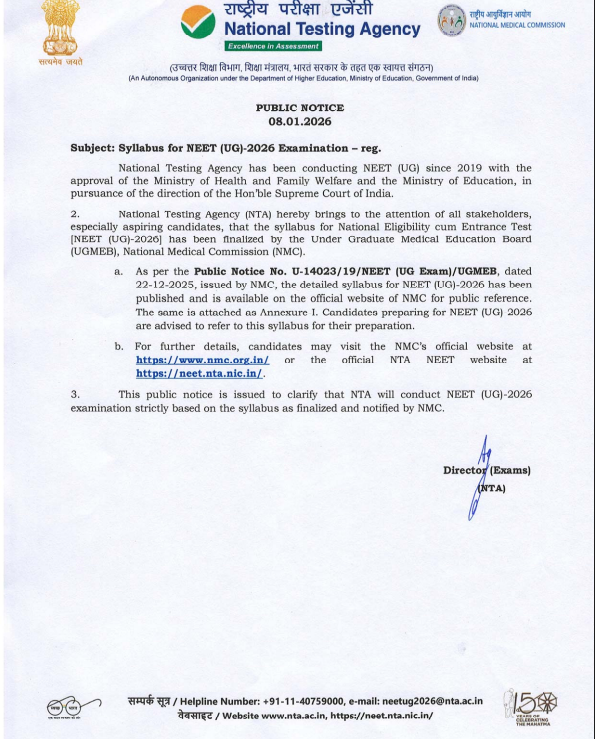
The NTA has yet to release the NEET 2026 syllabus pdf on their official website. It is assumed the syllabus will reflect the NEET 2025 syllabus and topics are drawn based on the NCERT Class 11 and Class 12 textbooks of Physics, Chemistry, and Biology. Only slight changes are expected in 2026.
There are some expectations about the official syllabus that it should be released by NTA around December 2025 but before that, it is most convenient to prepare according to the syllabus of 2025.
Read More: How Many Days Left for NEET 2026
NEET 2026 Biology Syllabus
|
Class 11 Biology Units |
Class 12 Biology Units |
|
Unit 1 – Diversity of Living World
|
Unit 6 – Reproduction
|
|
Unit 2 – Structural Organisation
|
Unit 7 – Genetics & Evolution
|
|
Unit 3 – Cell Structure & Function
|
Unit 8 – Biology & Human Welfare
|
|
Unit 4 – Plant Physiology
|
Unit 9 – Biotechnology & Its Applications
|
|
Unit 5 – Human Physiology
|
Unit 10 – Ecology & Environment
|
Read More: NEET Biology Important Diagrams
NEET 2026 Physics Syllabus
|
Class 11 Physics Units |
Class 12 Physics Units |
|
Unit 1 – Physical world & Measurement
|
Unit 1 – Electrostatics
|
|
Unit 2 – Kinematics
|
Unit 2 – Current Electricity
|
|
Unit 3 – Laws of Motion
|
Unit 3 – Magnetic Effects of Current & Magnetism
|
|
Unit 4 – Work, Energy & Power
|
Unit 4 – Electromagnetic Induction & Alternating Currents
|
|
Unit 5 – Motion of System of Particles & Rigid Body
|
Unit 5 – Electromagnetic Waves
|
|
Unit 6 – Gravitation
|
Unit 6 – Optics
|
|
Unit 7 – Properties of Bulk Matter
|
Unit 7 – Dual Nature of Matter & Radiation
|
|
Unit 8 – Thermodynamics
|
Unit 8 – Atoms & Nuclei
|
|
Unit 9 – Behaviour of Perfect Gas & Kinetic Theory
|
Unit 9 – Electronic Devices
|
|
Unit 10 – Oscillations & Waves
|
Read More: How to Study Physics for NEET 2026
NEET 2026 Chemistry Syllabus
|
Class 11 Chemistry Units |
Class 12 Chemistry Units |
|
Unit 1 – Some Basic Concepts of Chemistry
|
Unit 1 – Solid State
|
|
Unit 2 – Structure of Atom
|
Unit 2 – Solutions
|
|
Unit 3 – Classification of Elements & Periodicity
|
Unit 3 – Electrochemistry
|
|
Unit 4 – Chemical Bonding & Molecular Structure
|
Unit 4 – Chemical Kinetics
|
|
Unit 5 – States of Matter
|
Unit 5 – Surface Chemistry
|
|
Unit 6 – Thermodynamics
|
Unit 6 – General Principles & Processes of Isolation of Elements
|
|
Unit 7 – Equilibrium
|
Unit 7 – p-Block Element (Group 15, 16, 17, 18)
|
|
Unit 8 – Redox Reactions
|
Unit 8 – d-Block Element
|
|
Unit 9 – The Hydrogen Element
|
Unit 9 – f-Block Element
|
|
Unit 10 – The s-Block Element (Alkali & Alkaline Earth)
|
Unit 10 – Haloalkanes & Haloarenes
|
|
Unit 11 – The p-Block Element (Group 13, 14)
|
Unit 11 – Alcohols, Phenols & Ethers
|
|
Unit 12 – Organic Chemistry – Basic Principles
|
Unit 12 – Aldehydes, Ketones & Carboxylic Acids
|
|
Unit 13 – Hydrocarbons
|
Unit 13 – Amines
|
|
Unit 14 – Environmental Chemistry
|
Unit 14 – Biomolecules & Polymers
|
Read More: NEET Previous Question Papers with Solutions by CLC Sikar
NEET Chapter-Wise Weightage: At a Glance
|
Subject |
Chapter / Topic |
Approx. Weightage |
|
Physics |
Mechanics |
25 % |
|
Thermodynamics & Heat |
12 % |
|
|
Electrostatics & Magnetism |
15 % |
|
|
Optics |
10 % |
|
|
Modern Physics |
13 % |
|
|
Chemistry |
Physical Chemistry |
30 % |
|
Organic Chemistry |
34 % |
|
|
Inorganic Chemistry |
36 % |
|
|
Biology |
Diversity in Living World |
14 % |
|
Structural Organisation |
9 % |
|
|
Cell Structure & Function |
10 % |
|
|
Plant & Human Physiology |
30 % |
|
|
Genetics & Evolution |
18 % |
|
|
Ecology & Environment |
19 % |
Chapter Wise Weightage & Focus Areas
- Physics
- Mechanics (25 %) - Foundational and heavy-hitting (think Kinematics, Newton Laws, Rotational Motion).
- Electrostatics and Magnetism (15 %), Modern Physics (13 %) - Very important chapters that cannot be missed.
- It is important to note: Thermodynamics (12 %) and Optics (10 %).
- Target these in order to have a high-scoring opportunity.
- Chemistry
- The weightage of all the branches-Physical (30 %), Organic (34 %), Inorganic (36 %) is almost equal.
- The best approach: Get the Physical Structure solidified, learn the Inorganics (mainly, periodic table, coordination compounds) by heart and practice reaction mechanisms in Organic over and over again.
- Biology
- The section of Biology comprises close to 70 % being absorbed by Physiology (30 %), Genetics and Evolution (18 %), Ecology and Environment (19).
- Remaining - Diversity, Structure, Cell still need to be firmly conceptualized.
- The focus was brought into high-output areas to achieve optimized preparation.
Read More: Most Important Chapters for NEET
How to use the Syllabus and Weightage for Smart Preparation
- Devote your study time to high-weightage topics in each subject that maximizes the benefit of your time in studying.
- Build a strong NCERT foundation, this is often directly tested especially in Biology and Inorganic Chemistry.
- Use Past Year Questions (PYQs) to realize similar patterns and recognize the significant subtopics.
- Include topics that have moderate and low weightage as well.
- Study intelligently- Study more on high-yielding topics and not neglect other topics.
Best Study Material for NEET 2026 Preparation – Powered by CLC Sikar
To crack NEET 2026, the proper selection of study material plays a significant role other than hard work. Although NCERT is the core, one cannot just depend upon it because it is not sufficient to achieve the first rank. Due to this, our [Institute Name] NEET Study Material will enable students to achieve a 360 competitive advantage in term of their understanding of the concepts, NCERT completion, question bank, and rank-busters.
NEET 2026 Physics Study Material
|
Resource Type |
Why It’s Better |
|
Theory Modules |
Covers NCERT + advanced concepts with real-life examples for better understanding. |
|
Practice Questions |
Includes NCERT-based + tricky application questions frequently asked in NEET. |
|
Rank Booster Tests |
30+ chapter-wise mock drills + 10 full-length NEET mock tests aligned with NTA’s latest pattern. |
|
Special Add-ons |
Helps in last-minute revision and correcting repeated mistakes. |
NEET 2026 Chemistry Study Material
|
Resource Type |
Why It’s Better |
|
Theory Modules |
Every reaction, mechanism & NCERT line simplified for exam recall. |
|
Practice Questions |
Includes Assertion-Reason, Match the Column, Statement-based MCQs – high weightage in NEET. |
|
Crash Revision |
Perfect for last-minute preparation, highlights most important NCERT-based topics. |
|
Extra Edge |
Students solve chapter-wise previous year NEET & AIPMT questions with detailed solutions. |
NEET 2026 Biology Study Material
|
Resource Type |
Why It’s Better |
|
Theory Modules |
Line-by-line NCERT explained + extra diagrams & flowcharts for visualization. |
|
Practice Questions |
Most exhaustive NEET-style biology practice with detailed solutions. |
|
Rank Booster Sheets |
Handpicks every NCERT-important line likely to appear in NEET. |
|
Special Add-ons |
Quick recall tool for ecology cycles, plant physiology, genetics etc. |
Why Choose CLC Sikar Study Material?
- 100% NCERT Coverage with extra focus on high-weightage chapters.
- Created by Toppers and Expert Faculties.
- Covers the past 36 Years NEET papers + AIPMT questions
- AI-powered Test Analytics (available optionally in case you deliver digital test series).
Click Here to Get CLC Sikar Study Material
Get Your FREE 90-Day NEET 2026 Study Planner
Studying to pass NEET 2026 can be overwhelming because there are a lot of chapters, lines in NCERT, practice questions to go through. This is why we have come up with an exclusive 90-Day Study Planner that will help you manage, schedule and capitalize on your preparation in Physics, Chemistry, and Biology at CLC Sikar.
Our planner is suitable to those students who prefer having a structured plan instead of scrambling through books and notes.
What You Get in the 90 Day Planner
- Daily & Weekly Study Schedule
- Balanced coverage of Physics, Chemistry, and Biology each day
- Includes NCERT reading, NCERT practise and NCERT revision
- Chapter-Wise Targets
- Focus on the topics that have high weightage
- Assists you to monitor completion and confidence level
- Integrated Practice Sessions
- Daily MCQs and Assertion-Reason Practice
- Weekly full-length mock tests to stimulate the real NEET exam
- Revision/Doubt Solving Time
- Built-in revision days to consolidate memory
- Designed time to clear confusion with the teachers or online resources
- Easy-to-Use Digital Format
- Printable PDF or mobile-friendly version
- Read any time, any place, even without the Internet
How This Planner Helps You Score Higher
- Less Stress: Less stress as a roadmap is outlined.
- Increases Efficiency: Directs at key sections as well as frequently occurring NEET tendencies.
- Helps Increase Retention: A combination of theory, MCQs, and revision cycles in order to boost long-term retention.
Frequently Asked Questions:
- Has the NEET 2026 syllabus been reduced?
There is no confirmation so far, however, considering the trends, significant changes are unlikely.
- Can I prepare using the NEET 2025 syllabus now?
Yes, it is expected to be practically identical to NEET 2026.
- Which is the highest weightage subject?
There is biology (360 marks/100 questions), physics and chemistry (180 marks/45 each).
If looking for the best NEET coaching institute, enquire at CLC Sikar.
CLC Editorial Team
Our Latest Blog
NEET 2027 Sample Papers by CLC...
NEET preparation changes once you start solving quRead More
NEET UG Round 3 New 183 Seats:...
There are 183 more MBBS and BDS seats available inRead More
NEET 2027 Sample Papers by CLC...
NEET preparation changes once you start solving quRead More